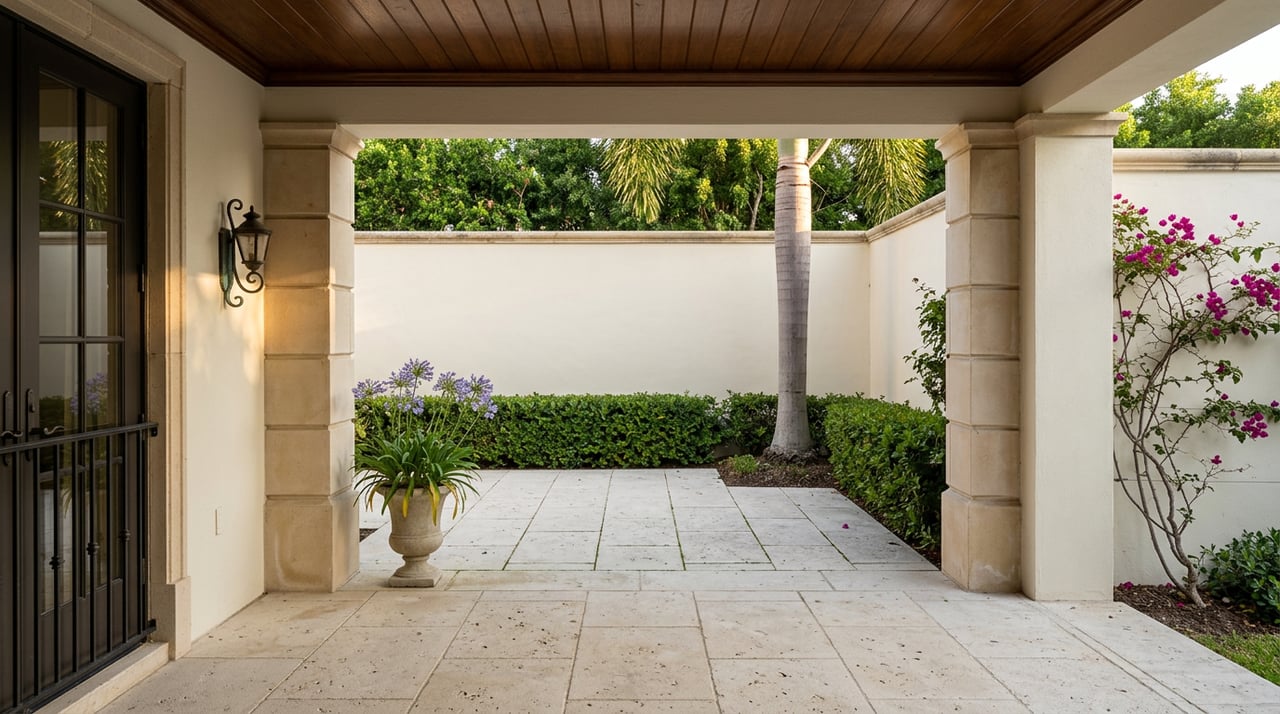
A buyer sees two Midtown estates listed within a mile of each other. Both are around 8,000 square feet. Both are asking in the mid-teens. One will close, permit, and break ground inside a year. The other will still be sitting in front of the Architectural Commission eighteen months from now, on its third remand, watching carry costs stack against a scheme that keeps failing on massing.
Nothing on the MLS explains the difference. It sits inside the Town of Palm Beach's review overlay, and it is the single input most portal shoppers never price.
The mechanism most Palm Beach buyers meet after closing
The Town's Architectural Commission, known locally as ARCOM, reviews the exterior of every new build and substantial alteration visible from a public right-of-way. Where a property is designated a historic landmark or sits inside a historic district, review shifts or runs in parallel with the Landmarks Preservation Commission under Chapter 54 of the Town Code. The Town publishes the current review calendar and application checklists through its Planning, Zoning and Development Review office.
On the ground, this means ARCOM alone adds roughly six to twelve weeks on top of a permit review that itself runs twelve to twenty weeks for a new single-family. Oceanfront parcels layer on Florida's Coastal Construction Control Line process, which on the island runs in series with ARCOM rather than parallel, adding another three to five months of idle time. A clean custom residence on Palm Beach Island typically needs four to six months from complete design documents to issued permit, then sixteen to twenty-two months of construction. The eighty or so significant single-family projects in permitting on the island at any given time bear this out: fewer than half deliver on the owner's original timeline, and the delay is almost never the general contractor.
Where you buy dictates what you can change
Palm Beach Island is not one review environment. It is at least four, and the boundaries between them are the closest thing the market has to zoning fault lines.
- Estate Section and Midtown. Much of Midtown, plus the Sea Street area and the El Brillo corridor in the South End, sits inside a historic district. Any parcel inside it is subject not only to ARCOM but to the historic preservation standards codified in Chapter 54. Additions must be subordinate in scale and differentiated in detail from the original. Exterior materials are reviewed to a specificity, down to stucco finish, roof tile profile, and window muntin width, that builders working elsewhere in Florida rarely encounter.
- North End. Looser overall, with pockets of overlay protection. Massing tends to be the pressure point on smaller lots rather than materials.
- Billionaire's Row and South Ocean Boulevard. ARCOM plus the Coastal Construction Control Line plus shoreline protection, stacked. The most valuable dirt on the island carries the densest review load.
- Worth Avenue district. Commercial storefront review is its own conversation. Recent ARCOM agendas show applicants at 259 Worth Avenue coming back for exterior modifications including signage, entry doors, and awnings, items that would be permit-desk decisions in most jurisdictions.
There are more than 328 landmarked properties, sites, and vistas currently protected under the Historic Preservation Ordinance, and the Landmarks Preservation Commission meets monthly to review changes to them. That is a lot of houses where the buyer's future kitchen remodel is not a private decision.
A concrete permit clock
For a buyer trying to model the timeline honestly, the sequence on a Palm Beach Island renovation or new build typically runs:
- Pre-application and scheme development. Four to eight weeks of design work before anything hits the Town's planning desk. Incomplete submissions are the single most common cause of downstream delays.
- ARCOM preliminary review. Presenting before the scheme is resolved is the classic mistake. The commission remands, and every remand costs a four-to-six-week cycle.
- Landmarks review, where applicable. Runs monthly on the third Wednesday. Demolition of any structure more than fifty years old can trigger this even without formal designation.
- Final ARCOM approval. Elevations at quarter-inch scale or tighter, material samples, window-detail drawings.
- Building Division permit review. Twelve to twenty weeks for a new single-family, subject to backlog.
- CCCL, on oceanfront parcels. Three to five additional months, in series.
- Construction. Sixteen to twenty-two months for a 6,000 to 10,000 square foot residence, assuming no substantial change orders.
The gap between a 24-month project and a 42-month one almost never opens up on the job site. It opens up between contract and groundbreaking, in review rooms the seller's disclosure package will not describe.
Historic renovations, specifically, tend to run fifteen to thirty percent higher than comparable work on non-historic properties, with two-to-six-month timeline extensions common. On a $5 million interior-heavy update, that is real money, and it lands on the buyer, not the previous owner.
What this does to per-square-foot pricing
Palm Beach Island produced 118.2% five-year appreciation, with an average home value around $9.8 million and a mid-2025 median single-family sale price near $12.9 million. Nearly seventy percent of first-half 2025 single-family closings on the island cleared $10 million. Those are the headline numbers a buyer arrives with.
The number underneath them is optionality. In the Douglas Elliman Eklund-Gomes weekly report covering June 22 to June 28, 2026, thirteen contracts totaling $114 million in asking dollar volume signed across Palm Beach County above $3 million, at an average of $1,437 per square foot and 97 days on market. A new-construction Boca Raton mansion at 481 Thatch Palm Drive went under contract at $2,082 per square foot. That Boca premium reflects, in part, a fact the review overlay makes obvious: the buyer is paying for a house that is already what it is going to be. On the island, part of the price gap between a landmarked Mizner or Fatio estate and a recently permitted new build in the North End is the difference between buying a home and buying a home plus a review process.
That is the interpretation the median hides. Two comparable-looking listings can carry twenty months of divergence in when the buyer's own design intent gets to exist.
Three questions to ask before you sign
For buyers comparing Palm Beach Island against Boca Raton, Delray Beach, or Palm Beach more broadly, the diligence questions worth putting on the table before signing:
- Is the parcel inside a historic district or individually landmarked? The answer changes which commission reviews your work and how much of the existing envelope you can alter.
- What is the age of the primary structure? Anything over fifty years old can trigger Landmarks review at the demolition stage regardless of designation.
- If oceanfront, has a CCCL application been contemplated? Because it runs in series with ARCOM on the island, it moves the groundbreaking date by a season, sometimes two.
None of these are hidden risks. They are managed risks, and the buyers who treat them as pricing inputs rather than surprises end up in the estates they actually wanted.
FAQ
Does ARCOM review interior work? No. The commission's authority is the exterior visible from public rights-of-way, plus landscaping. Interior scope moves through the Building Division and, on landmarked properties, can still touch Landmarks review if it affects protected features.
Can I close before ARCOM approval and start design after? Yes, and most buyers do. The tradeoff is that the renovation clock starts at closing rather than at contract, and carry costs during design and review are the buyer's to absorb. Modeling those months honestly is more useful than assuming a timeline the island's review pace does not support.
Are off-market estates any easier to renovate? The overlay is the same. What off-market access can offer is time, specifically the ability to run a pre-application dialogue with the Town before you own the parcel. That is where a discreet advisory relationship earns its cost. Palm Beach County's off-market luxury activity has grown noticeably through 2026 as buyers prioritize privacy and early access.
How does this compare to Boca Raton? Boca lacks a town-wide architectural commission, though HOA-based architectural review boards inside communities such as Royal Palm Yacht and Country Club, Woodfield, and Les Jardins impose their own approvals in parallel with city permits. The friction is present but distributed across private governance rather than concentrated in a single municipal body.
For buyers evaluating Palm Beach Island against the broader South Florida luxury corridor, the review overlay is not a footnote. It is a line item, and it belongs in the underwriting before the offer, not after the closing. If you would like a considered read on a specific parcel, its review posture, and how it compares to alternatives in Boca Raton, Delray Beach, or the mainland waterfront, Tayse Dantas is available for a private conversation. Let's Connect.